
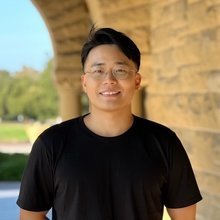
Sang Cheol Kim
Bio: Sang Cheol Kim went to Duke University for his undergraduate studies, with degrees in Mechanical Engineering and Materials Science (MEMS) and Chemistry. In college, Sang Cheol developed a deep interest in the energy transformation, which led him to join LG Chem, a large chemical and battery manufacturing company based in South Korea. After three years’ tenure at LG, as a battery cell engineer for automotive applications, he moved to Stanford, where he received master’s and PhD degrees in Materials Science and Engineering. He worked with Prof. Yi Cui to develop tools to probe the liquid electrolyte in batteries, and developed a new class of electrolytes called the high entropy electrolyte. Sang Cheol has also been active in the Stanford energy community as a student leader of the StorageX Initiative.
Postdoctoral research project: Ion-irradiated hBN nanomembranes for high-performance lithium metal batteries. Metallic lithium is the ultimate anode material for lithium-based batteries, as it provides the highest energy density. However, taming the reactivity of lithium metal to suppress lithium dendrites has been a long-standing challenge. In recent studies conducted in Prof. Steven Chu’s group at Stanford, it was found that ion-irradiated hexagonal boron nitrides (hBNs), a 2-dimensional material, on the anode can effectively suppress dendrite formation. Ion-irradiated hBN can selectively transport Li+ through defect sites, while inhibiting transmission of other components in the electrolyte thereby suppressing side reactions. Sang Cheol will leverage his expertise in electrolyte engineering and electrochemistry to build high-performance lithium metal batteries. By optimizing the interplay between the electrolyte and the hBN nanomembrane, he aims to design long-cycling and high-energy lithium metal batteries. In addition, the remarkable effect of defects in hBN brings forth fascinating scientific questions: 1) What is the nature of the radiation-induced defect and how does it lead to the physicochemical properties? 2) What hBN-electrolyte interfacial phenomenon allows for the selective insertion and transport of Li+? Sang Cheol will deploy advanced characterization tools available in Stanford and SLAC to find answers to these fundamental questions.
Research focus: Energy Conversion & Storage - Lithium metal batteries
Advisors: Steve Chu - Physics | Yan-Kai Tzeng - SLAC
Education
Ph.D., Materials Science and Engineering, Stanford University (2023)B.S., Mechanical Engineering & Materials Science, Duke University (2014)A.B., Chemistry, Duke University (2014)